
Why Intercom and Zendesk Can't Drop Per-Resolution Pricing
 Josh Bein· May 21, 2026
Every sharp buyer eventually lands on the same question.
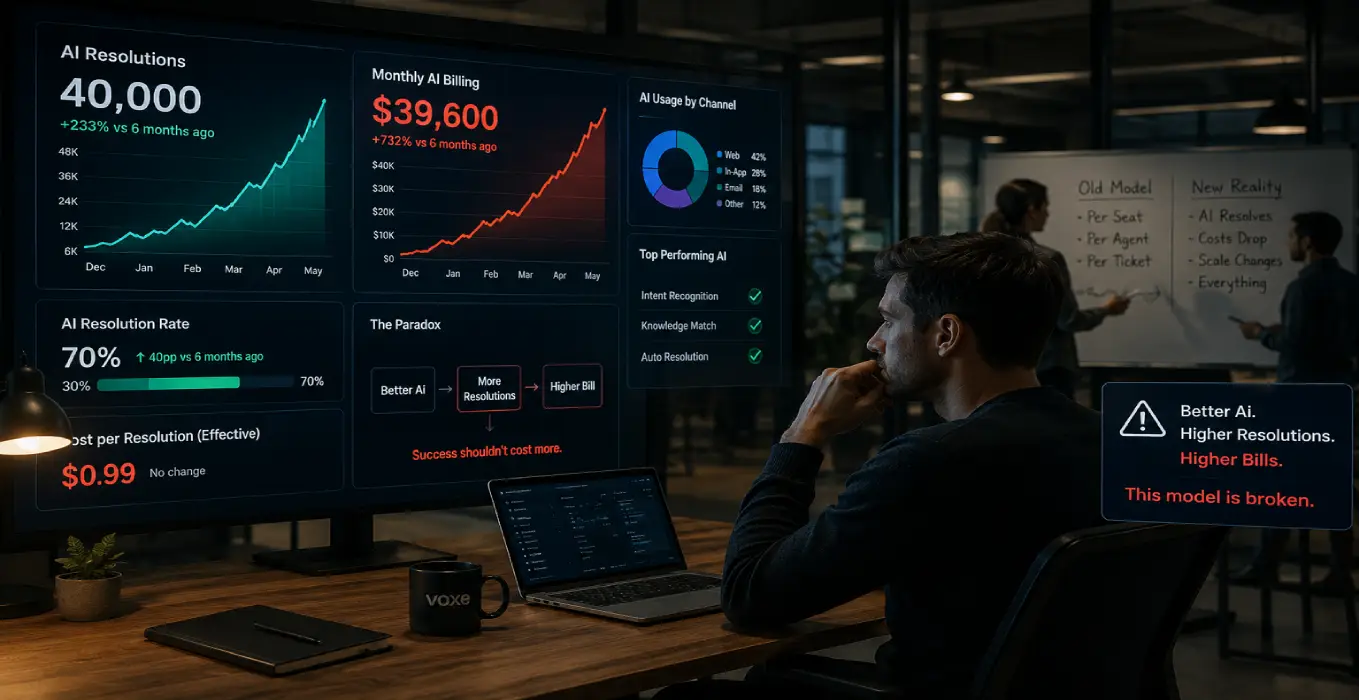
You've shown them the math. Per-resolution billing at $0.99 per ticket means 40,000 monthly resolutions costs $39,600 before any seat fees. You've shown them the G2 reviews, the Reddit threads, the pattern of teams reporting doubled invoices after their AI improved. They understand the problem.
Then they ask the logical follow-up: "Sure, but won't Intercom and Zendesk just change their pricing eventually? If it's this unpopular, why wouldn't they fix it?"
It's a reasonable question. The answer is more instructive than most people expect.
Key Takeaways
- AI inference costs fell roughly 280-fold between late 2022 and late 2024 (Stanford AI Index 2025), but per-resolution fees at incumbents have not moved with the curve.
- Per-resolution billing is not a pricing page decision. It's the primary mechanism through which legacy platforms monetize their AI investment.
- If incumbents keep per-resolution pricing, customers cap AI deployment to control cost. If they remove it, they eliminate a high-margin revenue stream with no ready replacement.
- Architecture overhead, investor expectations, and multi-year enterprise contracts make the transition a years-long process, not a quarter's work.
- Flat-rate coverage pricing is only structurally viable for platforms built on current AI economics, not the ones built before the cost curve inflected.
How Did Intercom and Zendesk Build Per-Resolution Pricing?
To understand why the pricing won't change, you have to understand why it exists. Intercom and Zendesk were both built as messaging and ticketing platforms before large language models existed. When AI became capable enough to resolve support tickets autonomously, Intercom launched Fin and Zendesk launched its AI agents on outcome-based pricing: charge per resolution, because resolutions are the value customers can clearly measure.
From a product perspective, that logic is not unreasonable. From a revenue modeling perspective, it was the right call in 2022 and 2023. AI resolution rates were low, around 20% to 30% for most teams at launch (Intercom Fin benchmarks), which meant per-resolution revenue was modest but growing predictably. As AI improved, resolution rates would climb. As resolution rates climbed, per-resolution revenue would compound. The growth curve looked excellent in every board deck.
What no one modeled carefully was the customer side of that same curve.
The cost of an AI inference call has been falling rapidly and consistently. According to the Stanford AI Index Report 2025, inference for a system performing at the level of GPT-3.5 fell from about $20 per million tokens in November 2022 to roughly $0.07 per million tokens for Gemini-1.5-Flash-8B in October 2024, a 280-fold drop in 18 months. The economics of serving an AI resolution improved by orders of magnitude. But legacy platforms did not pass those savings to customers. They maintained the per-resolution fee while their own costs fell, expanding margins on the AI layer while customers saw no benefit. The $0.99 per resolution fee that was introduced when AI inference was expensive remains in place now that inference is cheap.
That expanding margin is the number incumbents are protecting. That's why changing it is genuinely hard.
Why Is Changing Per-Resolution Pricing a Lose-Lose?
Incumbents face exactly two options on per-resolution pricing. Both are bad. The table below sums up the trade-off.
| Dimension | Path A: Keep Per-Resolution | Path B: Remove Per-Resolution |
|---|---|---|
| Customer behavior | Caps AI deployment to limit invoices | Deploys AI broadly, no usage anxiety |
| Effect of AI improvement | Higher invoices for the customer | Lower marginal cost, no revenue lift |
| Revenue trajectory | Grows with AI adoption (in the short term) | Drops by the size of the per-resolution line |
| Churn risk | Accelerates among high-volume customers | Hits enterprise multi-year contracts at renewal |
| Investor narrative | "AI is monetizing well" (until churn shows up) | "We're rebuilding the revenue model" (hard sell) |
| Time to execute | Already in place | Multi-year repricing across thousands of contracts |
Path A: Keep per-resolution billing
If Intercom and Zendesk keep charging per resolution, the following dynamics continue and intensify. Teams who have improved their AI start noticing that better performance produces higher invoices. The connection between success and cost becomes impossible to ignore once resolution rates pass 50%. Finance teams, already skeptical of unpredictable SaaS spend, begin requesting caps on AI deployment scope. Support managers set confidence thresholds artificially high so the AI escalates more and resolves less, limiting billing exposure by limiting the tool's effectiveness.
The platform that was supposed to reduce support costs becomes the reason support costs remain high. Every quarter, teams run the math: the savings from AI automation divided by the per-resolution fees. As resolution rates improve, that math gets worse. A team saving $8,000 per month in human labor that pays $6,000 per month in resolution fees has a thin case for the investment at current pricing, and the case gets thinner as AI continues to improve.
Churn among high-volume customers, precisely the customers who are most valuable in a SaaS model, accelerates. The platforms that charge per resolution end up with a customer base that actively under-uses their AI to manage costs. That is not a stable product-market dynamic.
Path B: Remove per-resolution billing
If Intercom and Zendesk remove per-resolution fees, they face a different set of problems, and these are worse from a business perspective.
Per-resolution billing is not a minor line item. For platforms with high AI adoption, it represents a significant portion of the revenue that appears in the AI category on their income statements. Intercom has publicly discussed AI as a growth driver, and that growth is monetized largely through Fin. Zendesk's AI agents work on a similar model. Removing per-resolution billing means removing the primary mechanism through which AI usage converts to revenue.
What replaces it? The options are not appealing:
Higher seat fees. This shifts the billing trigger back to headcount, which is exactly the metric AI is supposed to reduce. A team that deploys AI to cut from ten agents to four would pay less under seat-based pricing, the opposite of the revenue outcome incumbents need.
Higher flat platform fees. This works for low-volume customers but loses high-volume customers who currently pay substantial per-resolution bills. The highest-paying customers under the current model would pay the same flat fee as the lowest-volume customers. Revenue would fall.
Volume-based chat fees. This moves in the right direction. Charge for conversation volume rather than resolution outcomes. But it requires repricing thousands of existing enterprise contracts, rebuilding billing infrastructure, and explaining to investors why a growing revenue metric is being deliberately reduced. That's a multi-year operational and narrative challenge.
None of those paths allow incumbents to replace per-resolution revenue cleanly or quickly. The structure that generates the revenue is also the structure customers are increasingly frustrated by. That's the lose-lose.
Why Is This Structural and Not Just a Pricing Page Update?
When buyers hear this analysis, a common response is: "Sure, but eventually the competitive pressure will force them to change." That's true in theory. In practice, several forces slow this down significantly.
Architecture costs. Intercom and Zendesk were not built to run AI at the cost efficiency of platforms that launched after 2023. They carry significant infrastructure overhead from years of acquisition, product expansion, and engineering on pre-AI architecture. A newer platform built exclusively on current model APIs, with no legacy infrastructure to maintain, can offer flat-rate AI pricing because its margins allow it. An incumbent with higher underlying costs cannot match that pricing without margin compression that exceeds what current valuation multiples support.
Investor revenue expectations. Both Intercom and Zendesk have shareholders, board members, and (in Zendesk's case, private equity owners) who have underwritten their investments based on AI revenue as a growth lever. Per-resolution billing growing alongside AI adoption is a thesis that's been presented to capital allocators. Voluntarily removing or significantly restructuring that revenue stream requires a credible replacement narrative that doesn't yet exist.
Enterprise contract dynamics. Large enterprise customers at Intercom and Zendesk are under multi-year contracts with negotiated per-resolution rates. Repricing those agreements requires renegotiation at renewal, which means the existing revenue base continues under the current model for the duration of those contracts. Any pricing change propagates slowly through the customer base, making a rapid transition structurally impossible even if the strategic decision were made today.
The precedent problem. Voluntarily reducing a pricing metric that has been growing acknowledges, publicly, that the metric was unfair. That creates legal and customer-relations exposure with teams that have paid significant per-resolution fees and might reasonably seek retroactive remediation. Incumbents will not make that acknowledgment unless competitive pressure is acute enough to force it.
The combination of these factors means meaningful change to per-resolution billing at incumbents is a multi-year process, not a quarter's work. Teams making platform decisions today are making them against the pricing model that exists, not the one that might eventually emerge from competitive pressure.
What Should You Do If You're Choosing a Platform Today?
According to McKinsey research on the economic potential of generative AI, customer operations is one of the four functions capturing the largest share of generative AI's productivity gains. Understanding the structural pricing trap has practical implications for any team currently using, renewing, or evaluating Intercom or Zendesk.
At renewal, your per-resolution rate is a negotiating point but not a structural change. Incumbents will discount per-resolution rates under volume commitments. They will not remove the mechanism. A discounted per-resolution rate is still a per-resolution rate. Your bill still grows with AI performance, and the dynamic that makes the model frustrating persists at a lower price per unit.
Growth-stage companies are most exposed. A company that's growing fast, improving AI resolution rates, and handling increasing ticket volume is exactly the profile that generates compounding per-resolution costs. The true cost of customer support at scale makes the most sense to model before growth, not after a year of unexpected invoices.
The value of AI automation is being partially captured by your vendor. When your AI resolution rate improves from 30% to 60%, the efficiency gain you produce is partially transferred to your vendor as revenue. A better AI system that saves you $10,000 in labor costs may simultaneously generate $8,000 in incremental resolution fees. The net saving is real but significantly smaller than the gross improvement suggests.
Platform lock-in is a real risk at high resolution volumes. Teams paying $15,000 to $30,000 per month in resolution fees are making an implicit argument that switching costs are lower than that ongoing expense. But switching at that scale also requires migrating a knowledge base, rebuilding workflows, retraining the team, and managing a parallel-run period. In our experience working with teams migrating off Intercom and Zendesk, the complexity of the move is real but usually overstated, which is why switching is simpler than most teams expect when approached methodically.
Why Is Flat-Rate AI Pricing Only Available on Newer Platforms?
The flat-rate coverage model, where you pay for access to the platform rather than for each resolution the AI produces, is only structurally viable for platforms built after AI inference costs fell to their current level. A platform built on current-generation model APIs, with modern infrastructure, can offer a plan that includes substantial AI resolution volume at a flat monthly rate because the underlying cost of those resolutions permits it. When the marginal cost of an AI response is a fraction of a cent, flat-rate pricing is economically sustainable. When AI inference was expensive in 2021 and 2022, it was not.
This is not a competitive advantage in the traditional sense. It's a timing advantage. Platforms that launched after the AI infrastructure cost curve inflected can build their business models around the economics that exist today. Incumbents built their monetization models around the economics that existed when they introduced AI. They cannot easily rebuild those models without rebuilding their entire revenue architecture.
The implication is that the per-resolution pricing trap is most acute for incumbents right now, during the period when AI costs have fallen dramatically but customer contracts and investor expectations still reflect the old cost structure. As time passes, competitive pressure will eventually force a reckoning. But that reckoning is measured in years, not quarters. The teams that understand this transition now are in the best position to act before the pressure forces incumbents to respond.
FAQ
Why don't Intercom and Zendesk just lower their per-resolution fees?
They do, for large enterprise customers under volume commitment contracts. The discount brings the per-resolution rate down, but the mechanism remains. A lower per-resolution fee still means your bill grows as your AI improves. The underlying dynamic, success as a cost driver, persists at a lower price per unit.
Isn't the competitive market solving this already?
The market is creating pressure, but it works on long cycles in enterprise software. A team locked into an annual Zendesk contract doesn't change platforms because a competitor offers better pricing. They change at renewal, after an evaluation cycle, a budget approval, and a migration plan. Competitive pressure will eventually force a response, but teams making decisions today are deciding against current pricing.
Could incumbents just absorb the margin compression and offer flat-rate AI?
In theory, yes. In practice, this would require explaining to shareholders why a growing revenue metric is being deliberately reduced, accepting margin compression on the AI layer, and having a credible replacement growth story ready. That kind of business change typically requires a new leadership mandate or sufficient competitive pressure to justify.
What should a team do if they're already on a per-resolution contract?
Model your resolution rate trajectory before your next renewal. If your AI investment is working, your per-resolution costs will compound over the remaining contract term. That projection is the number to bring to renewal negotiation, and it's the number that makes the case for switching to a coverage-based model when the contract allows.
Is this problem unique to Intercom and Zendesk?
It applies to any AI support platform with per-resolution pricing as the primary AI monetization mechanism. Intercom's Fin and Zendesk's AI agents are the most widely deployed examples, but the structural trap is a function of the pricing model, not the specific vendor. Any platform that chose to monetize AI through outcome-based billing faces the same dilemma.
The per-resolution pricing trap is not the result of bad intentions. It's the result of a reasonable set of decisions made at a specific moment in time, when AI was expensive, when resolution rates were low, and when the cost curve was not yet clearly understood. Those decisions made business sense in 2022.
They make less sense in 2026, when AI inference costs have fallen by more than two orders of magnitude and well-deployed systems routinely resolve a majority of inbound tickets. The gap between what it costs to serve an AI resolution and what customers are charged for one has widened substantially. That gap is the margin incumbents are protecting.
Understanding that dynamic doesn't require assuming bad faith. It requires understanding that the companies who built their AI revenue models on per-resolution fees have a structural conflict of interest with customers whose goal is to deploy AI as broadly and effectively as possible.
The platform that benefits most when your AI improves is not always the one charging you for each improvement it produces.