
Best Customer Support Software for 2025: Compared
 Josh Bein· November 6, 2025
Choosing the right customer support software in 2025 shapes how quickly you resolve issues, how much you spend per ticket, and whether your team can scale without burning out. The market has shifted fast: AI agents now handle substantial ticket volumes, per-seat pricing models are under pressure, and customers expect sub-minute response times around the clock. This guide compares five leading platforms — Voxe, Zendesk, Intercom, Fin by Intercom, and Freshdesk — so you can make a confident, informed decision.
TL;DR
- Zendesk reports that 72% of customers expect an immediate response when contacting support (Zendesk CX Trends 2024).
- Gartner projects that by 2026, AI will handle 40% of all customer interactions without human intervention (Gartner, 2024).
- Companies using hybrid AI-plus-human models see average handle times drop by 25–35% compared to agent-only teams (Forrester, 2024).
- G2 data shows helpdesk software satisfaction scores correlate most strongly with ease of setup and quality of AI automation, not feature count (G2 Grid Report, 2025).
- Per-seat pricing remains the biggest cost complaint among support leaders at companies with more than 20 agents — a structural problem explored in depth in our post on why per-seat pricing is killing your support budget.
What to Look for in Customer Support Software
The best platform is the one your team will actually use effectively — fast to set up, honest in its AI claims, and priced so you can afford to grow into it. Evaluate any tool against these five criteria before committing.
1. AI Capability and Transparency
Does the platform use AI to resolve tickets autonomously, or just to suggest responses to agents? Look for published resolution rates and honest documentation about what the AI cannot handle. Vague claims about "AI-powered" features without specifics are a red flag.
2. Routing and Escalation Logic
Smooth handoffs between AI and human agents are non-negotiable. A poor escalation experience — where customers have to repeat themselves — erases any efficiency gain. Ask vendors how context is passed at the handoff point.
3. Pricing Model and Total Cost
Per-seat pricing balloons as your team grows. Usage-based or flat-rate models are more predictable. Calculate the cost at two scenarios: your current headcount and double it. The difference reveals how punishing the model gets at scale. For a detailed breakdown, see our analysis of the real cost of customer support.
4. Time to Value
Enterprise setups can take weeks of professional services. SMB tools often promise same-day launch. Know which category you're in and hold vendors to realistic timelines rather than sales-deck estimates.
5. Integration Depth
CRM, e-commerce, billing, and communication channel integrations determine whether the platform fits into your existing stack or forces workarounds. Shallow integrations through Zapier are not equivalent to native connectors.
The Best Customer Support Software for 2025
Voxe
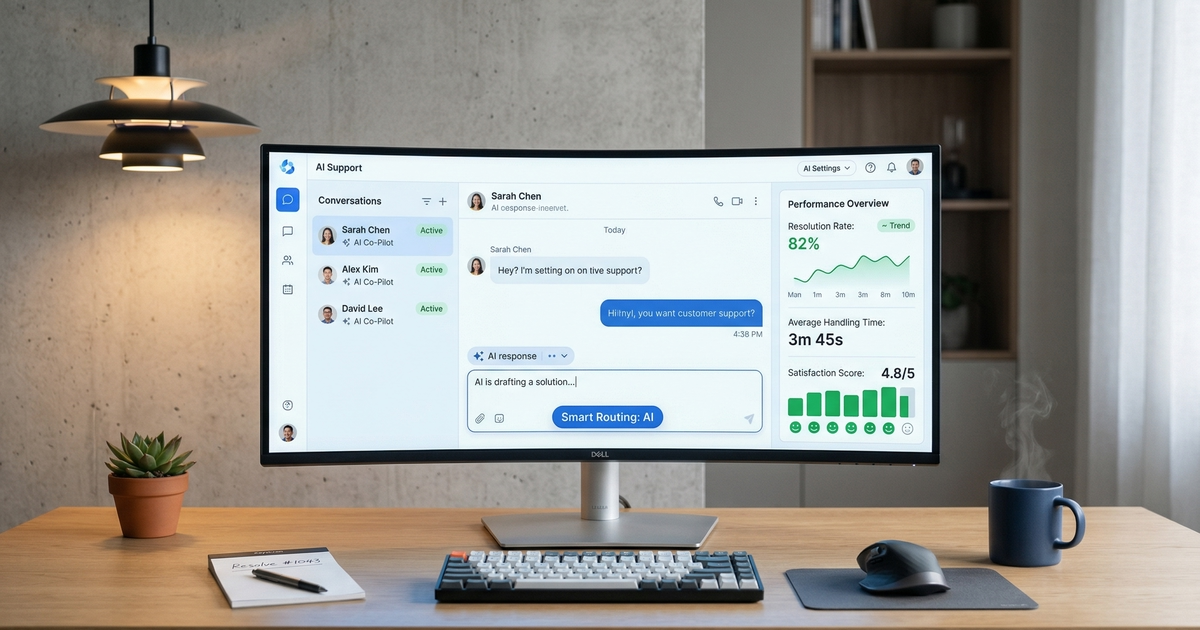
Voxe is an AI-plus-human hybrid platform built on the Fusion AI infrastructure. It auto-builds a knowledge base by scanning your existing website and documentation, then uses Fusion AI's NeuroSwitch routing to select the right AI model for each query — balancing cost and accuracy dynamically. When a query exceeds the AI's confidence threshold, it escalates to a human agent with full conversation context attached. Pricing is flat-rate rather than per seat, which means adding agents does not linearly increase your bill. The main limitation is that Voxe is a newer entrant: its third-party integration library is smaller than Zendesk's, and its reporting dashboards are less mature.
Zendesk
Zendesk is the incumbent for enterprise support teams. Its ticket management, SLA tracking, and analytics are genuinely best-in-class, and its app marketplace covers hundreds of integrations. The tradeoff is cost and complexity: Zendesk's per-agent pricing becomes expensive above 50 seats, and initial configuration — including AI features — typically requires dedicated admin time or a solutions partner. AI automation is available but sits behind higher-tier plans. For large enterprises with established IT processes, Zendesk is a defensible choice. For leaner teams, the overhead is often disproportionate to the need.
Intercom
Intercom pioneered the conversational CRM category and remains the strongest option for proactive, lifecycle-driven customer engagement. It excels at in-app messaging, onboarding flows, and outbound campaigns alongside reactive support. Pricing scales steeply with contact volume and feature tier, making it costly for high-volume support teams that primarily need reactive ticket resolution. The product suite is broad, which is both its strength and its source of complexity — teams that want a focused support tool often find Intercom's marketing and sales features add noise.
Fin by Intercom
Fin is Intercom's AI support agent, built natively into the Intercom platform. It uses large language models to resolve common questions autonomously, drawing on content from your Help Center and configured knowledge sources. Intercom reports that Fin resolves a meaningful share of incoming conversations without human involvement, though resolution rates vary significantly based on how well the knowledge base is maintained. Fin is not a standalone product — it requires an Intercom subscription — so its value is tightly coupled to whether Intercom is already the right platform for your business. Teams already on Intercom will find Fin a natural upgrade; those evaluating from scratch should consider it as part of the full Intercom cost.
Freshdesk
Freshdesk targets small and mid-sized businesses with a clear, accessible interface and a free tier that covers the basics for teams of up to 10 agents. Its automation is primarily rule-based rather than AI-driven, which limits its ability to handle unstructured or nuanced queries. The paid plans add more routing logic and AI-assisted suggestions, but the platform is not designed to compete with Voxe, Intercom, or Zendesk on AI resolution rates. For teams that need a clean ticketing system at low cost and are not yet ready for AI-first support, Freshdesk is a sensible starting point.
Comparison Table
| Platform | Best For | AI Capability | Pricing Model | Free Trial |
|---|---|---|---|---|
| Voxe | Growth-stage and global teams | Multi-LLM routing, autonomous resolution, human handoff | Flat-rate (no per-seat scaling) | Yes |
| Zendesk | Large enterprises | AI suggestions, automation on higher tiers | Per-agent, per-month | Yes (14 days) |
| Intercom | SaaS with proactive engagement needs | Conversational AI, outbound automation | Per-seat + contact volume | Yes (14 days) |
| Fin by Intercom | Teams already on Intercom | Autonomous AI resolution via Help Center | Included in Intercom plans | Via Intercom trial |
| Freshdesk | SMBs with basic ticketing needs | Rule-based automation, AI suggestions | Per-agent (free tier available) | Yes (21 days) |
How to Choose the Right Tool for Your Business
No single platform wins across all scenarios. Use the following framework based on your company profile.
Early-Stage Startups (Under 10 Agents)
Start with Freshdesk's free tier or Intercom's starter plan to validate your support workflow before committing to a larger platform. At this stage, the priority is learning what question types you receive, not optimizing AI resolution rates. Once patterns emerge — and if ticket volume exceeds what one or two agents can handle manually — re-evaluate with AI-first platforms. Building a clean knowledge base early, as outlined in our guide to setting up your AI knowledge base in Voxe, makes migration to any AI-driven platform faster.
Mid-Market Companies (10–100 Agents)
This segment benefits most from hybrid AI platforms. Per-seat pricing starts to create real budget pressure, and the volume of repetitive questions justifies AI automation. Voxe's flat-rate model and Fusion AI routing make it well-suited here. Zendesk is viable if you have existing workflows built on it, but factor in the admin cost of maintaining its configuration. Intercom fits if proactive messaging and CRM integration are as important as ticket resolution.
Enterprise Teams (100+ Agents)
Zendesk's SLA management, audit logging, and enterprise security features — including HIPAA compliance options — address requirements that smaller platforms have not yet matched. At this scale, the per-seat cost is often absorbed into larger IT contracts. AI capability remains important, but so is reliability, uptime guarantees, and the ability to integrate with legacy CRM and ERP systems. Evaluate Zendesk and Voxe in a parallel pilot if AI resolution rates are a strategic priority.
E-Commerce and High-Volume Support
High ticket volumes with predictable, repeatable question types (order status, returns, shipping delays) are the strongest use case for AI-first platforms. The economics shift rapidly: at 10,000 tickets per month, even a modest AI resolution rate translates to significant agent hours recovered. For context on what support teams face at scale, see our post on why your support team is always overwhelmed.
FAQ
What is the best customer support software for small businesses?
Freshdesk is the most accessible starting point for small businesses, with a free tier covering up to 10 agents and straightforward ticket management. For small teams that are growing fast and want AI automation from day one, Voxe's flat-rate pricing avoids the per-seat cost spiral that hits most tools as headcount increases. The right choice depends on whether you prioritize cost minimization or automation capability.
How much does customer support software cost in 2025?
Pricing ranges from free (Freshdesk's entry tier) to over $100 per agent per month for enterprise Zendesk plans. Mid-market teams on per-seat tools typically spend $25–$65 per agent per month. AI-first platforms with flat-rate pricing can be more economical once you cross 15–20 active agents, since cost no longer scales with headcount. Always calculate total cost of ownership, including setup, admin time, and integration development.
What is the difference between a helpdesk and an AI support platform?
A helpdesk is a ticketing and routing system: it organizes incoming requests, assigns them to agents, and tracks resolution. An AI support platform goes further — it attempts to resolve tickets autonomously using language models and a knowledge base, only routing to humans when the AI cannot handle the query. The gap is narrowing as legacy helpdesks add AI features, but purpose-built AI platforms generally achieve higher autonomous resolution rates with less manual configuration.
Can AI customer support software replace human agents?
Not entirely, and the strongest platforms are not designed to. AI handles high-volume, repeatable queries well — FAQs, status checks, policy questions. It underperforms on emotionally complex situations, multi-step account issues, and anything requiring judgment outside its training data. Gartner's 2024 projection of 40% AI-handled interactions implies 60% still involve humans. The goal is an effective hybrid, not elimination of the human tier. Teams navigating this balance will find the AI vs human hybrid support framework useful.
How long does it take to set up customer support software?
Setup time varies sharply. Freshdesk can be live in hours for a basic configuration. Intercom and Zendesk typically take one to three weeks when accounting for workflow design, integration, and agent training. AI-first platforms require knowledge base preparation in addition to standard setup — but tools like Voxe that auto-build from your website significantly reduce that burden. Budget two to four weeks for any platform if you want AI automation configured properly, not just the ticketing layer active.
Voxe is the platform behind this blog. We have made every effort to represent competing tools fairly and accurately. Corrections are welcome via our contact page.