
Support Software Is Becoming Infrastructure in 2026
 Josh Bein· May 21, 2026
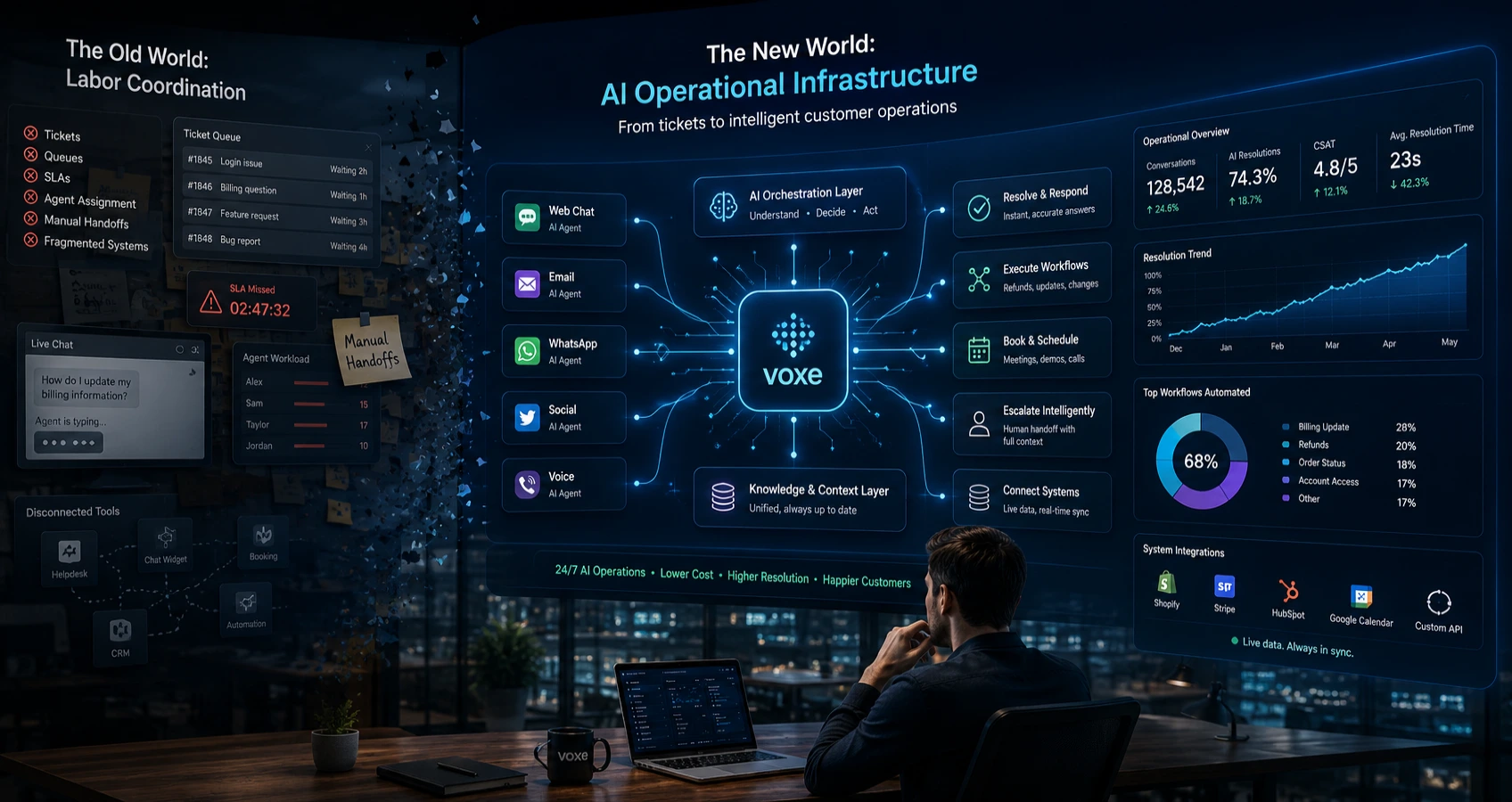
For twenty years, customer support software was built to solve one problem: organizing human labor.
The entire architecture of the category reflects that origin. Tickets exist because humans need a unit of work to track. Queues exist because humans can only handle one conversation at a time. SLA timers exist because humans need accountability structures. Agent assignment rules exist because humans need to know whose job it is. CSAT surveys exist because humans need performance feedback loops.
Every feature, every metric, and every pricing model in the legacy support software category was designed around one implicit assumption: serving customers at scale requires coordinating a lot of human effort.
That assumption is no longer true. The category is changing around it, whether the incumbents are ready or not.
Key Takeaways
- AI inference costs fell roughly 280-fold between late 2022 and late 2024 (Stanford AI Index 2025), breaking the per-resolution pricing model that defined legacy support software.
- The unit of value is shifting from "human handling a ticket" to "AI system resolving at near-zero marginal cost and escalating with judgment."
- Infrastructure charges for capacity, not per output. AWS, Stripe, and Twilio all follow this pattern, and AI support infrastructure is moving the same way.
- Companies on labor-coordination platforms pay a structural tax that widens as AI performance improves. Companies on operational-layer platforms accumulate compounding advantages.
- The transition is already underway and bifurcated: some companies operate at the infrastructure layer today, while others remain on legacy stacks.
Why Was Support Software Built for Labor Coordination?
The first generation of support software solved a real coordination problem. Zendesk launched in 2007 and Intercom launched in 2011. Before these platforms, support operations ran on shared email inboxes, spreadsheet trackers, and informal knowledge held by long-tenured agents. Tickets went unanswered. Context was lost. SLAs were aspirational. Customer history lived in one person's head.
What these platforms built was coordination infrastructure for human teams. A shared inbox became a structured queue. An email became a ticket with a status, an owner, and a timestamp. Agent performance became measurable. Customer history became searchable. Support went from a chaotic inbox to a managed process.
That was a real and meaningful improvement. The category earned its growth. But the category was built on human-scale assumptions. Every architectural decision reflected the reality that support, at its core, was people answering questions for other people. The software was there to help them do that better, not to do it for them.
That framing produced the right products for 2007. It produces the wrong products for 2026.
What Changed in AI Support, and Why Now?
The change is not that AI exists. AI has existed in various forms for decades. The change is the price of running it. According to the Stanford AI Index Report 2025, inference for a system performing at the level of GPT-3.5 fell from about $20 per million tokens in November 2022 to roughly $0.07 per million tokens for Gemini-1.5-Flash-8B in October 2024. That is a 280-fold drop in 18 months.
That cost curve is the hinge. When AI inference was expensive, per-resolution pricing was a reasonable way to share the cost between platform and customer. When AI inference is nearly free, per-resolution pricing is a margin extraction mechanism, and flat-rate infrastructure pricing becomes economically viable for the first time.
The cost curve also changed what AI can do inside a support context. Modern retrieval-augmented generation systems can pull precise answers from a knowledge base, access live business data through integrations, execute multi-step workflows, and escalate with full context when judgment is required. The AI is not answering from a static script. It's operating inside the business's actual information environment.
Combined, these two changes (dramatically lower inference costs and dramatically higher capability) move AI support from a productivity add-on to something that deserves a different category name entirely.
Three other forces accelerated the timing:
The vibe-coded startup explosion. Millions of products have been built and shipped in the past two years by solo founders and small teams who cannot afford enterprise support stacks. These businesses have real customers with real questions. They need support that works without a team behind it. The onboarding problem in vibe-coded apps is precisely this: products built fast without the guidance layer that turns curious users into retained ones.
SMB accessibility. Enterprise-grade AI support used to be inaccessible to smaller businesses, not because the technology was limited, but because the pricing was built for enterprise contract structures. When per-resolution billing generates a five-figure monthly bill at moderate volume, it self-selects for large enterprises. Flat-rate infrastructure pricing makes the same capability available to a ten-person company.
The fragmented stack problem. Most companies currently run support across five or more disconnected tools: a helpdesk, a chat widget, a booking system, a workflow automation layer, and a CRM integration. The Zendesk CX Trends Report repeatedly finds that fragmented tooling drives both customer frustration and operational cost. Each tool produces its own data, billing, and maintenance overhead. The full cost of running a fragmented support stack (including the engineering time spent maintaining integrations that keep breaking) rarely shows up in a single budget line.
What Is the Customer Support Category Transition?
Category transitions in software follow a recognizable pattern. They don't happen when a product in an existing category gets significantly better. They happen when the underlying unit of value changes.
Salesforce didn't make CRM faster. It changed what CRM was, from a database of contacts to a system of record for customer relationships, accessible anywhere, connected to communication channels, and generating actionable data at scale. The category became something new.
AWS didn't make servers cheaper. It changed what infrastructure was, from a capital expense requiring physical ownership to an operating expense priced by actual use, elastic to demand, and managed by someone else. The category became something new.
The transition happening in customer support follows the same pattern. The unit of value is changing from "human agent handling a ticket" to "AI system resolving at near-zero marginal cost, escalating with judgment, and operating as part of the business's live operational environment."
That is not a faster helpdesk. That's a different thing.
The new category has a name the incumbents have not fully adopted, because adopting it would mean acknowledging their current products are in the old one: operational infrastructure.
What Does Operational Support Infrastructure Actually Do?
The distinction between a labor coordination tool and an operational layer is clearest when you look at what each one can and cannot do.
| Capability | Labor Coordination Tool | Operational Infrastructure |
|---|---|---|
| Customer question | Routed to a human queue | Resolved by AI; escalated with judgment if needed |
| Knowledge base | Static documentation for agents | Live retrieval source for the AI itself |
| Business data | Surfaced to the agent | Accessed directly by the AI to answer specifically |
| Workflows | Manual handoffs and ticket transitions | Automated execution (returns, bookings, updates) |
| Escalation | Resets the conversation context | Preserves full conversation, account state, and summary |
| Availability | Bound to agent shift schedules | 24/7, around the clock |
| Pricing | Per-seat or per-resolution | Coverage-based by capacity |
The AI and human hybrid escalation model is not a feature of the operational layer. It's the fundamental design principle. AI handles everything that is predictable and structured. Humans handle everything that requires judgment, empathy, or authority. The handoff between the two preserves context instead of resetting it.
Concretely, an operational layer:
- Responds in under two seconds across every connected channel, around the clock
- Retrieves from a knowledge base that reflects the actual state of the business: updated documentation, current pricing, live product information
- Connects to business data systems to give specific answers ("your order ships Thursday" rather than "orders typically ship in 3 to 5 days")
- Executes workflows: booking a meeting, processing a return, updating an account detail, opening a ticket in the right queue
- Escalates with judgment when confidence thresholds, emotional signals, or request complexity exceed its defined operating scope
- Keeps the human agent informed during the waiting period so no customer ever experiences silence
None of those capabilities fit inside the labor coordination category. They belong to a different category entirely, one that's just beginning to develop the vocabulary, the pricing models, and the architectural patterns that will eventually look obvious in retrospect.
Why Does Support Infrastructure Pricing Look Different?
One reliable signal of a category transition is that the pricing model changes in a way that previously made no sense.
On-premise software was licensed per-seat because that was the natural unit of value when you owned the software and ran it yourself. SaaS made per-seat pricing reasonable in a new context: you're renting access, so the number of people accessing it determines the price. Both models make sense for labor coordination tools.
Infrastructure is priced differently. AWS charges for compute time, storage capacity, and data transfer, not per HTTP request served. Stripe charges per transaction, the business event itself, not the API call executing it. Twilio charges per message and per minute, the communication unit, not the engineering work of enabling it.
The right pricing model for AI support infrastructure is coverage-based: charge for the system's operating capacity (active support chat count, monthly API call volume, number of human agents in the helpdesk) rather than for each resolution the AI produces. Charging per resolution is the old category's logic applied to new infrastructure, and it produces the old category's dysfunction: the better the system performs, the more you pay.
Infrastructure charges for capacity because infrastructure is always on. The value is availability, not output. An AI that answers 500 questions this month and 5,000 next month shouldn't cost ten times more in November than in October. The system's value is that it is there: ready, accurate, and capable, regardless of how often it's called upon.
What Should Companies Choosing a Support Platform Do Today?
Most companies evaluating support software today are making a decision that will compound for three to five years. The knowledge base they build, the escalation logic they tune, and the workflows they automate all improve over time with actual deployment data. Switching later means starting that compounding curve later. According to McKinsey research on the economic potential of generative AI, customer operations is one of the four functions capturing the largest share of generative AI's productivity gains, with the largest benefits going to teams that integrate it deepest into operations rather than bolting it on as a feature.
The question is not just "which product has the best features today?" It's "which category am I building on?"
If you build on a labor coordination platform, your support architecture will improve at the pace of human hiring and training. Your costs will scale with headcount. Your AI usage will be constrained by a pricing model that charges for each resolution, creating a financial incentive to under-deploy the AI capability you're already paying for. You'll eventually face the same repricing problem every team faces when per-resolution volumes grow: the math stops working, and switching becomes more expensive than staying.
If you build on an operational infrastructure platform, your support architecture improves as the AI accumulates context, as the knowledge base reflects actual customer questions, and as escalation logic tunes to real patterns in your conversations. Your costs stay flat as volume grows within your plan capacity. Your AI deployment is constrained by the quality of your knowledge base, not by a billing mechanism that punishes good performance.
The teams that moved to cloud infrastructure early didn't just save money. They could build things that on-premise teams could not. The operational advantage compounded. The same dynamic is available to teams that move to AI-native support infrastructure before it becomes the obvious default.
Which Companies Are Still Stuck in the Old Category?
There's a specific business profile most exposed to the current category transition: fast-growing companies where support volume scales with user acquisition, currently running on Intercom or Zendesk, with AI adoption limited by per-resolution billing. In our experience working with SMBs migrating off these platforms, the same pattern shows up repeatedly. An AI tool is bolted onto the existing helpdesk. Deployment scope is capped to control billing. The operational benefits never compound.
These companies are paying an infrastructure tax in two directions. First, they're paying per-resolution fees that grow as AI performance improves, a direct transfer of efficiency gains from customer to vendor. Second, they're leaving AI deployment scope constrained because finance teams, seeing the per-resolution math, cap the AI's reach to control costs.
The result is a support operation running at a fraction of its potential efficiency, on a platform that has a structural conflict of interest with improving that efficiency. The full cost of customer support for these teams includes not just what they pay their vendor, but what they're not saving because the pricing model discourages full AI adoption.
This is not a permanent condition. Competitive pressure from AI-native infrastructure platforms will eventually force incumbents to respond. But that response is constrained by the structural trap described elsewhere, and it will take years, not quarters, to materialize into a meaningfully different pricing model from the companies currently most exposed.
FAQ
How is operational infrastructure different from a better chatbot?
A chatbot answers questions from a fixed script. Operational infrastructure accesses live business data, executes multi-step workflows, escalates with context, and integrates into the business's operational environment. The difference is between a static responder and a live participant in how the business serves customers. A chatbot is a feature. An operational layer is a system.
Is this category transition already happening?
Yes, unevenly. Companies that deployed AI-native support platforms are already operating at the infrastructure-layer model: flat-rate pricing, full AI deployment, escalation that preserves context. Companies still on legacy platforms operate at the labor-coordination model with AI as an expensive add-on. The transition is a current state of bifurcation between two categories coexisting in the market.
Does this mean human agents are no longer valuable?
The opposite. In an operational infrastructure model, human agents handle exclusively the cases that require their judgment: complex disputes, emotionally charged situations, high-stakes account decisions. They are no longer buried under repetitive questions that AI handles better and faster. Agent quality matters more, not less.
How long does it take to build on an AI-native infrastructure platform?
Significantly shorter than the legacy alternative. AI-native platforms are designed for fast deployment: submit a business URL, the system generates a knowledge base and deploys a live AI system within minutes. The compounding benefit, where the knowledge base improves and escalation logic tunes, happens over weeks and months of actual deployment, not years of implementation.
What signals that a platform is operating as infrastructure rather than a labor tool?
Three signals: pricing is coverage-based rather than per-resolution or per-seat, the system connects to live business data rather than serving only static documentation, and escalation preserves full context rather than resetting the conversation when a human takes over. All three reflect the shift from organizing human work to replacing it for the tasks AI handles better.
Twenty years from now, the idea that businesses ran their customer support on software designed to coordinate human agents will look as dated as running a business on on-premise servers managed by a dedicated IT team. The category transition is not a prediction. It's a description of what's already underway.
Companies that understand it now have a specific advantage: they can build on the new category before it becomes the default. The knowledge base compounds. The escalation logic tunes. The AI gets better with real deployment data. Starting that process in 2026 is different from starting it in 2029, not because the technology will be less available then, but because the advantage of an earlier start will already belong to someone else.
The infrastructure is here. The only question is whether you are building on it.