Why PLG Companies Need AI Support That Scales
 Josh Bein· April 7, 2026
Product-led growth is built on a radical premise: let the product sell itself. AI support has to operate on an equally radical premise — let the product support itself. Most PLG companies nail the first half and walk straight into a wall on the second. They engineer viral loops, frictionless signups, and self-serve upgrades — then bolt on a traditional helpdesk that charges per seat, responds in 48 hours, and requires a human being to be awake. That is a structural mismatch. And at scale, it is fatal.
TL;DR — Five numbers every PLG founder should know:
- PLG companies grow 2x faster than sales-led peers but carry lower average revenue per account in early stages, making cost efficiency at the per-user level non-negotiable. (OpenView Partners, 2024 Product Benchmarks)
- Users who don't reach their first "aha moment" within 7 days have a 60–80% higher churn rate. (Gainsight / Forrester)
- 52% of users who encounter friction during onboarding abandon the product within the first session. (Amplitude, 2024 Product Report)
- 55% of people have returned a product because they didn't fully understand how to use it. (Wyzowl Customer Education Report, 2024)
- 32% of customers will walk away after just one bad experience. (PwC Consumer Intelligence)
The PLG Support Paradox
PLG is designed to grow without a sales team. It is not designed to grow without a support model. That distinction is where most product and CX leaders lose the thread.
In a sales-led motion, bad support costs you a renewal conversation. In a PLG motion, bad support costs you the user before they ever become a renewal — and they leave without filing a complaint, without sending an email, without giving you a reason. They just stop logging in.
The cost of bad support in PLG is not a bad review. It is silent churn. And silent churn is the hardest problem in SaaS to diagnose because it leaves no ticket trail.
How PLG users differ from sales-led users
A user who came in through a sales motion was onboarded by a human. They had a kickoff call. They have a named CSM. When they hit a wall, they send an email or open a Slack channel.
A PLG user signed up at 11pm on a Tuesday. Nobody walked them through the product. They are self-directed, asynchronous, and operating in a zero-patience environment. They expect answers the way they expect WiFi — instant, invisible, always on. According to the Salesforce State of Service 2024, 61% of customers already prefer self-service for simple issues. PLG users aren't the exception to that trend. They set the benchmark for it.
Why tickets don't work in PLG
Tickets are the wrong channel, the wrong speed, and the wrong moment. They require the user to leave the product, describe a problem in words, wait for a response, return to the product, and attempt to apply the fix — usually hours or days later, after context has evaporated and motivation has cooled.
That workflow was designed for enterprise software where the user has contractual reasons to stay. PLG users have no such obligation. They have ten alternative tools in their browser bookmarks. A ticket queue is not a support system for them. It is an exit ramp.
Why Traditional Helpdesks Break PLG Unit Economics
The per-seat helpdesk model has one fatal flaw for PLG companies: it charges you for growth.
Every time your user base expands, your support cost expands with it. Not because your ticket volume necessarily scales linearly — but because the pricing model assumes it does, and you pay for the infrastructure regardless. That is the opposite of PLG economics, where the whole point is to decouple revenue growth from headcount growth.
Per-seat pricing scales with headcount, not with actual usage or value delivered. If your product doubles its user base, you are expected to double your support agents, double your helpdesk licenses, and absorb the cost of double the onboarding time for new hires. The math on per-seat support pricing breaks down fast for any team trying to scale without proportional headcount.
The 5,000–10,000 user wall
PLG companies tend to hit a specific inflection point around 5,000 to 10,000 users where this structural flaw becomes impossible to ignore. Below that threshold, a scrappy support setup — a shared inbox, a small team wearing multiple hats — can absorb the load. Above it, ticket volume compounds, response times slip, and the cost of scaling support starts to visibly erode the unit economics that made PLG attractive in the first place.
An illustrative cost model
Consider a product with 10,000 active users. Assume a 5% monthly contact rate — 500 support interactions per month. At a traditional per-seat helpdesk, supporting that volume at adequate response times typically requires three to five agents, with per-seat licensing costs layered on top of salaries and overhead. Costs scale with every new cohort of users. The full accounting of what customer support actually costs — salaries, tools, training, management, and the revenue impact of slow response times — shows why this model compounds so fast.
With a flat-rate AI support layer, those same 500 interactions — plus the next 500 as the product grows — are handled without adding headcount or changing the pricing tier. The marginal cost of user 10,001 is effectively zero. That is not a feature comparison. It is a different economic model entirely.
(Note: Specific dollar figures vary by vendor and team configuration. The structural point — flat cost vs. linear cost — holds across all configurations.)
What "Scales With Users" Actually Means
Scaling with users does not mean "getting bigger." It means that as user volume increases, support quality stays constant and cost per interaction decreases. Most traditional support infrastructure does the opposite: quality degrades under load while cost per interaction rises.
AI support scales with users structurally, not aspirationally. Here is what that looks like in practice.
Instant, in-product answers at the moment of friction
The user is inside the product. They are stuck. The answer needs to appear where they are, in the context they are operating in, in under five seconds. A link to a help center is not that. A chatbot that requires them to navigate to a separate URL is not that. In-product, context-aware AI that surfaces the right answer at the right moment is that.
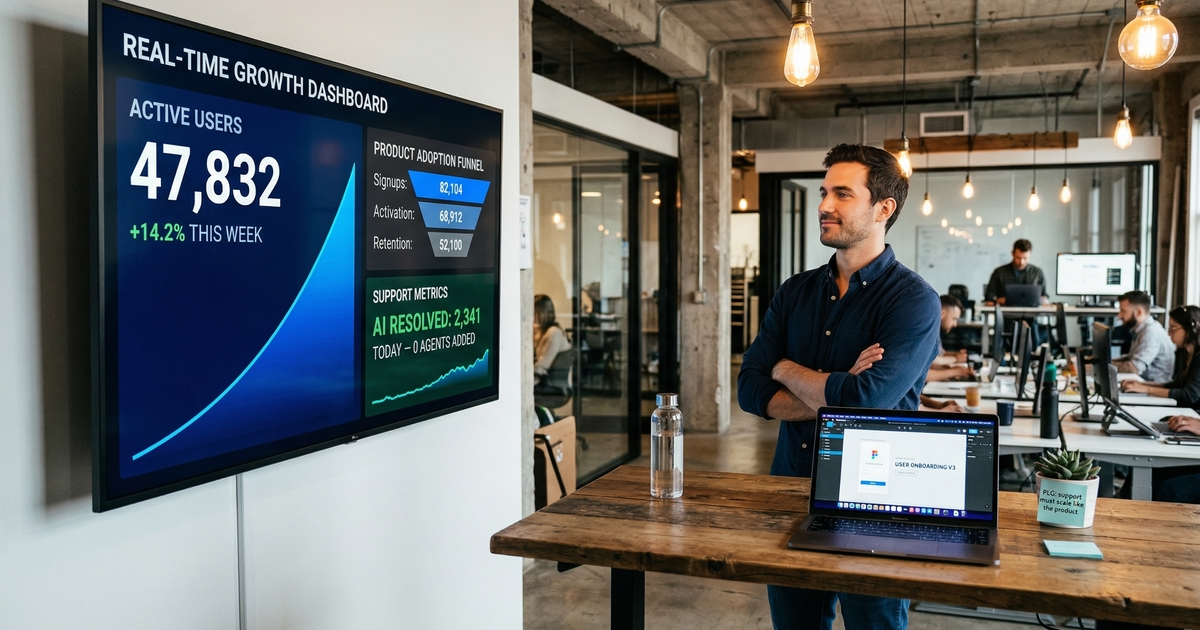
This is also where the Amplitude data becomes concrete: 52% of users who encounter friction during onboarding abandon the product within the first session. The intervention window is not hours. It is seconds. What AI actually handles well in the onboarding window is precisely this class of problem — deterministic, doc-answerable, time-sensitive questions that would never justify a human response but absolutely justify a precise, instant one.
Consistent onboarding support at 2am (no human coverage required)
PLG signups don't happen during business hours. A significant share of self-serve SaaS signups occur evenings and weekends, when no support team is staffed. The user who signs up at 2am and hits a setup question either gets an answer or they don't come back.
Human coverage at 2am requires either a globally distributed team or an on-call rotation — both of which are expensive and unsustainable for a PLG company at the 1,000- to 10,000-user stage. AI support has no shift schedule. The response quality at 2am is identical to the response quality at 2pm.
Zero marginal cost per additional user interaction
This is the economic crux. In traditional support models, the 10,000th user interaction in a month costs roughly the same to serve as the 100th. In an AI support model with flat-rate pricing, the 10,000th interaction costs a fraction of the first, because the infrastructure cost is already sunk.
This is what "scales with users" means at the unit economics level: the cost curve bends downward as volume grows, not upward.
Escalation to humans reserved for expansion and retention moments that matter
AI support is not about eliminating human interaction. It is about reserving human interaction for the moments where a human genuinely moves the needle — an expansion conversation, a churn-risk intervention, a high-touch enterprise inquiry. A well-designed escalation model keeps humans in the loop for the moments that require judgment, context, and relationship. Everything else should be handled before a human ever sees it.
The Four Support Moments That Make or Break PLG Retention
Retention in PLG is not determined by a single interaction. It is determined by how the product handles four specific moments. Get these right and churn drops. Get them wrong and no amount of activation campaign fixes the problem downstream.
Moment 1: First login and onboarding
This is the highest-stakes support moment in PLG. According to Gainsight and Forrester research, users who don't reach their first "aha moment" within 7 days have a 60–80% higher churn rate. The onboarding window is not a week — it is the first session. The first 15 minutes of a user's experience with your product sets the probability distribution for everything that follows.
Support at this moment must be proactive, not reactive. The user should not have to ask a question. The AI should anticipate where confusion occurs — based on product telemetry and common drop-off patterns — and surface guidance before the user hits a wall.
Moment 2: The first friction point
The user has passed onboarding. They are trying to do the thing the product is supposed to do. Something doesn't work the way they expected. This is the second critical juncture.
Support teams that are already underwater on ticket volume cannot respond to this moment at the speed PLG requires. By the time a human responds to a ticket, the user has either figured it out (and feels unsupported), given up (and started evaluating alternatives), or worked around the problem in a way that will cause a bigger issue later. None of those outcomes are good.
AI support handles this moment by intercepting the friction in-product — detecting the error state, the repeated failed action, the confusion signal — and delivering a targeted answer without requiring the user to leave the product or file anything.
Moment 3: The "is this the right plan?" question
This is an upgrade decision moment. The user has found value and is now asking whether they should pay more for more. This question gets asked in a chat widget, in a search bar, in a help center. If the answer is slow, generic, or requires a sales call to get, the user makes a decision based on incomplete information — and often downgrades that decision to "not right now."
AI support can answer this question with precision: here is what the next plan includes, here is what you would unlock based on your current usage, here is what other users at your stage typically do. That is a conversion moment dressed up as a support moment.
Moment 4: The re-engagement moment
The user signed up, used the product twice, and has not logged in for two weeks. This is the quiet-churn signal that most support systems never see — because no ticket was filed. The user did not ask for help. They just stopped.
AI-driven support infrastructure, integrated with product telemetry, can detect this pattern and trigger a targeted re-engagement — a contextual nudge, a "you left off here" prompt, a "here's what you might be missing" message. This is not marketing automation. It is support at the right moment, delivered without a human ever being looped in.
How to Build a Support System That's Actually PLG-Compatible
PLG-compatible support is not a product category. It is a design philosophy. Four principles define it.
In-product. Support must live where the user is. If the path to an answer requires leaving the product, you have already lost a percentage of users who will not make that trip.
Instant. Response time must be measured in seconds, not minutes or hours. The Amplitude data is unambiguous: friction during onboarding ends sessions. The intervention window does not accommodate ticket queues.
Context-aware. The support system must know what the user is doing, where they are in the product, and what they have already tried. Generic answers to specific in-product questions are not support — they are search engine results with a chat interface.
Cost-flat. The pricing model for your support infrastructure must not scale with user volume. Any support tool with per-seat pricing for agents, or per-ticket pricing at scale, will eventually become an argument for not growing.
What to look for in an AI support tool for PLG
Evaluate on three non-negotiables. First, pricing must not scale linearly with user volume or interaction count — flat-rate or usage-capped models are structurally compatible with PLG; per-seat and per-ticket models are not. Second, the knowledge base must be buildable from existing documentation — product docs, changelogs, help center articles — without requiring a manual content team to maintain it. Third, escalation to human agents must be configurable and intelligent, routing only the conversations that require human judgment, not every conversation that the AI found ambiguous.
Voxe is built on all three of these constraints. But the framework applies regardless of which tool you evaluate.
FAQ
What is product-led growth support?
Product-led growth support is the practice of delivering customer support in a way that matches PLG's core motion: self-serve, in-product, and instant. Unlike traditional SaaS support — which assumes a sales-assisted onboarding and a named customer success relationship — PLG support must operate without human intervention for the majority of interactions, because PLG users are self-directed and expect answers at the moment of friction, not after a ticket queue.
Why do PLG companies struggle with customer support at scale?
PLG companies struggle with support at scale because traditional support infrastructure is priced and designed for linear growth — more users means more agents, more licenses, and more cost per interaction. PLG growth is non-linear by design. The unit economics of per-seat helpdesks are structurally incompatible with user bases that can grow 10x in a quarter without a commensurate increase in revenue per user. The result is a cost wall that appears somewhere between 5,000 and 10,000 users for most teams.
Can AI replace human support for PLG companies?
AI should handle the majority of PLG support interactions — onboarding questions, feature explanations, workflow confusion, plan comparison, and basic troubleshooting — because these are deterministic, doc-answerable questions that don't require human judgment. Human support should be reserved for expansion conversations, complex churn-risk interventions, and enterprise-tier relationships where judgment and relationship context genuinely matter. The goal is not to eliminate human support but to make it rare and high-value, rather than routine and high-volume.
How do you reduce churn during PLG onboarding?
Reduce onboarding churn by shortening the time to the first "aha moment." Gainsight and Forrester research shows that users who don't reach that moment within 7 days are 60–80% more likely to churn. Practically, this means intercepting friction before the user abandons — with in-product AI guidance that surfaces contextual answers without requiring the user to file a ticket or search a help center. Proactive support, triggered by behavioral signals rather than user-initiated requests, is more effective than reactive support at this stage.
What's the difference between PLG support and traditional SaaS support?
Traditional SaaS support is reactive, ticket-based, and human-staffed — appropriate for enterprise customers who have contractual relationships and dedicated success managers. PLG support must be proactive, in-product, and AI-first — because PLG users have no human relationship, no contractual obligation to stay, and no patience for asynchronous channels. The difference is not just tooling. It is a fundamentally different assumption about who the user is, how they arrived, and what they will do if they don't get an answer in the next thirty seconds.