
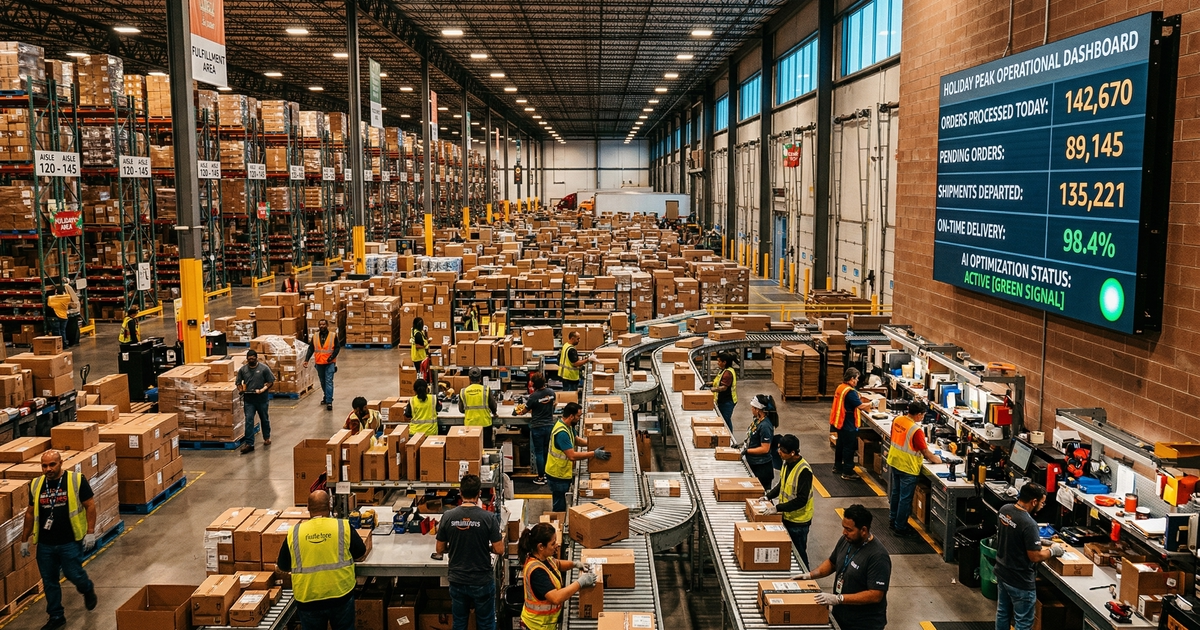
How an E-Commerce Brand Survived Peak Season Without Hiring
 Olga Taran· April 6, 2026
Every year, the same thing happened. A growing online home goods retailer would spend October dreading November. Their support inbox — manageable at 300 tickets a day during quiet months — ballooned to 1,200+ daily during the holiday window. The math never worked: hiring seasonal agents took weeks, cost more than the budget allowed, and left two full-time staff members babysitting temporary hires instead of handling the complex cases only they could resolve. In 2024, they tried a different approach.
TL;DR
- A home goods e-commerce brand faced 4× ticket volume during peak season with no viable path to scale headcount proportionally.
- They deployed Voxe three weeks before peak season, uploading their returns policy, shipping documentation, and 200+ SKU product specs.
- During the 6-week peak window: 81% of tickets resolved automatically, first response time dropped from 5.8 hours to 2.1 hours, CSAT rose from 88% to 94%.
- Seasonal staffing spend: $31,000 the prior year. Voxe cost during the 6-week period: $180.
- Their two full-time agents handled only escalated tickets — arriving pre-documented with full conversation context.
The Problem: Peak Season Support Is a Staffing Math Problem That Doesn't Add Up
The standard response to a holiday ticket spike is hiring. But the economics of seasonal support hiring are worse than they appear.
According to the Society for Human Resource Management, the average cost to hire a new employee is $4,700 — and that's before training time, onboarding supervision, and the inevitable quality drop from agents who have been on the job for two weeks. Per the Baymard Institute, 70.19% of online shopping carts are abandoned; customers who do complete a purchase and then have a poor post-purchase experience are significantly less likely to return. The cost of a bad support interaction compounds into retention loss.
For this retailer, the seasonal hire model had a second failure mode: the agents they hired weren't equipped to handle product-specific questions across a 200+ SKU catalog. Customers with detailed questions about care instructions or product compatibility got vague answers, escalated to the full-time team anyway, or left without a resolution.
The volume problem and the quality problem were both staffing problems. Adding more temporary staff solved neither.
The Setup: Three Weeks, Two Agents, One Knowledge Base
The team didn't start from scratch. Everything they needed to train a support system already existed — they just needed to surface it.
Three weeks before peak season, they uploaded their core documentation into Voxe:
- Full returns and exchange policy, including the holiday extension window
- Shipping carrier information and estimated delivery timelines by region
- Product care instructions and compatibility notes for each SKU category
- Common order issue resolution steps (wrong item shipped, damaged in transit, missing package)
- Promo code terms and conditions for the holiday campaign
The knowledge base was indexed within a day. From there, they ran simulation tests — entering the questions they expected most — and refined the AI's system message to match their brand voice: warm, direct, and specific. Not robotic, not vague.
They also connected Voxe's workflow integration to their order management system. For the single highest-volume query type — "where is my order?" — the AI could now pull live tracking data and respond with real shipment status, not a placeholder redirect to a tracking page.
A well-maintained knowledge base alone handles 50–70% of support ticket volume for most e-commerce businesses. With the order management integration in place, this team pushed that ceiling significantly higher.
During Peak: 81% Resolution Rate, No New Headcount
The 6-week holiday window ran from the third week of November through the end of December. Daily ticket volume peaked at 1,280 — 4× their baseline.
The AI handled 81% of those tickets without human involvement. That left their two full-time agents managing 243 tickets per day at peak — slightly below their normal baseline of 300. For the first time, the holiday season was less stressful than a normal week.
| Metric | Prior Year (Seasonal Staffing) | This Year (Voxe) |
|---|---|---|
| Daily ticket volume (peak) | 1,100 | 1,280 |
| Tickets requiring human response | 940 (85%) | 243 (19%) |
| Avg. first response time | 5.8 hours | 2.1 hours |
| CSAT score | 88% | 94% |
| Seasonal staffing spend | $31,000 | $0 |
| Voxe plan cost (6 weeks) | — | $180 |
Response time dropped from 5.8 hours to 2.1 hours — not because agents were faster, but because the AI answered most tickets within seconds of receipt. The small percentage requiring human review waited in a queue that was 80% shorter than the prior year.
CSAT increased from 88% to 94%. The team attributed this to two things: faster response times across the board, and more consistent answers. When a customer asked about the holiday return extension policy, the AI gave the same accurate answer every time. There was no variation based on which agent picked up the ticket.
How Escalation Actually Worked
The two full-time agents weren't replaced. They were redeployed.
Instead of triaging every incoming ticket, they only received conversations that Voxe escalated: complaints, refund requests above a threshold, or conversations where the customer expressed frustration early in the exchange. This is the case for human support that matters most — the high-stakes conversations where judgment and empathy are irreplaceable.
Every escalated ticket arrived with full conversation context intact — what the customer asked, every AI response, and the reason for escalation. Agents didn't read back through threads. They entered the conversation already oriented and responded immediately.
"The escalated tickets were actually the best-documented ones we'd ever seen. The AI basically pre-filled the context for us." — Support Team Lead
This is the design intent of a properly built escalation chain: the AI handles what it can handle, and when it can't, it hands off with everything the human needs already prepared.
The One Gap: Proactive Communication
Looking back, the team identified one area for improvement: proactive communication during service disruptions.
Mid-season, a shipping carrier experienced regional delays. The support inbox spiked with "where is my order?" tickets from affected customers — even though Voxe answered each one correctly using live tracking data. The team wished they'd gotten ahead of the inbound volume by messaging affected customers before they reached out.
That workflow is now in place for the next season: an automation that monitors order tracking status against expected delivery windows and sends proactive delay notifications to affected customers automatically. The ticket doesn't get created because the customer already has the information.
Per Salesforce's State of the Connected Customer report, 73% of customers expect companies to understand their needs before they have to explain them. Proactive communication during a carrier delay is exactly that understanding in practice.
What This Shows About Peak Season Support
The conditions that made this work aren't specific to this retailer. They apply to most e-commerce businesses facing seasonal volume:
The questions are predictable. Returns, shipping, order status, and product details account for the overwhelming majority of peak-season ticket volume. These are bounded, answerable questions — and a knowledge base that covers them thoroughly gives an AI system nearly everything it needs. The full breakdown of peak-season support costs — including seasonal staffing, overtime, and quality degradation — shows why this matters financially.
The documentation already exists. Every retailer has a return policy, carrier information, and product specs. The gap is rarely the documents — it's the system to surface them at speed and scale.
The cost math changes fundamentally. Per-seat pricing scales linearly with headcount. Coverage-based pricing doesn't — the platform cost stays flat while resolution volume increases. At $180 for a 6-week peak window versus $31,000 in seasonal staffing, the economic case isn't marginal. It's structural.
Human capacity is preserved for what humans do best. When agents stop triaging routine tickets, they have capacity for the conversations that actually require judgment. Support quality goes up precisely because human attention is focused, not diluted.
FAQ
How long did setup take before peak season?
Three weeks. The bulk of that time was preparing and uploading the documentation — the actual knowledge base indexing completed within a day. The team spent the remaining time running simulation tests and tuning the AI's system message for brand voice consistency.
What happened to tickets the AI couldn't resolve?
They escalated to the human support team with full conversation context attached. The team's two full-time agents only saw escalated tickets — which meant they were handling 243 tickets per day at peak instead of the 1,100 the prior year's seasonal staff managed.
Did customers know they were talking to an AI?
The team chose transparent disclosure — the chat interface identified itself as an AI assistant. Customers who preferred human support could request it at any point, triggering an escalation. Escalation requests were a small fraction of total volume.
What's the risk if the AI gives a wrong answer?
The AI answers from the knowledge base — it doesn't invent information. For this retailer, the main accuracy risk was outdated documentation. Their pre-season setup process now includes a documentation review specifically timed to the knowledge base upload, to ensure policy details like holiday return extensions are current before peak begins.
Does the AI handle order management integration out of the box?
The order management integration required connecting Voxe's workflow layer to their OMS via API. This is a configuration step, not a development project — but it does require an API from the order management system. Retailers running Shopify, WooCommerce, or similar platforms with standard APIs can typically configure this connection without custom engineering.
What does this cost to run?
This retailer was on a Team plan that covers their API call volume tier. During the 6-week peak, total Voxe spend was $180 — the plan's standard monthly cost prorated. Additional usage beyond quota runs at raw API cost with no markup, so high-volume periods don't generate surprise overage bills.
Customer metrics based on the retailer's internal support reporting for the 6-week period November–December 2024. Details anonymized at the customer's request.